Mbon Yaní: Mode of Selection of a Chief
In old Mambilla system, a dying chief usually named his successor in advance. His will was respected. If however, no successor was clear before the vacancy occurred, the Bàtaribí would meet in two or three sittings to determine successor. Upon the death of Mbon Nòrrkùmàl of Mvùrrbò in May 1947, for instance, the Bàtaribí Council of Mvùrrbò under Kwúlduà Farrduà met three times at Tikerr to nominate Mbon (Pastor) John Ndùma.
They were following long-established tradition whichever the case, the elders looked out for appropriate qualities in the candidate in reaching their decision. Upon the occurrence of a vacancy in the Stool of the Chief, usually after the Chief's death, there usually follows a year-long mourning period in which no new Chief is crowned.
For instance, after the deaths of Mbon Mbònngwii of Gam in c. 1870, Mbon Siwuro of Mbun (Mbungnu) in c. 1919, Mbon Nyiarrdua of Ndiim Liimila in 1922, Mbon Ngwina of Kuma in 1929, and Mbon Nòrrkùmàl of Mvùrrbò in 1947, no successors were immediately named until the succeeding years.
The official Mún-nyu (Nyu) retains the royal emblems and acts in the position of the Chief. If no suitable candidate is found within one year of the last Chief's death, the Nyu continues to act until the next Chief is crowned, at which occasion the Nyu hands over all the emblems of Chieftaincy to the new Chief. During the mourning year, the Elders meet secretly to consider a possible successor.
They take into consideration all the required qualities present in the tentative candidates, which must, as a general rule, be male descendants of the previous Chief(s), or in the absence of any in the line, any Nyu of the previous Chief's. In most cases, the appropriate heir is usually known to the public.
Their final candidate is kept secret until the mourning period ends or nears its end. Then, one of the Elders, a Nyu of the Chief's family can 'appoint' the new Chief (ya Ngwa/Mbon). He does this by coming upon the would-be Chief unannounced and placing the Tìinyìarrì or Tìinyìa (Buffalo Tail Switch) on the chosen candidate's forehead, and announcing the appointment by chanting 'Ngwamû! Ngwamû!'. He reports this to the Elders' Council.
At this stage, the news of the appointment goes round the community. This officially makes the candidate the Chief-designate. What remains is the Coronation Ceremony, which inaugurates his tenure. The consent of the candidate is not usually sought in advance, nor does he have to canvass for support to become a Chief.
Patrilineal successor is generally preferred over and above a matrilineal successor. Gerontocratic considerations commonly overshadow direct descent criterion, and as Percival (1938 Reorganization, para. 38) saw in his few year in Mambilla, the successor finally selected is “not usually the chief’s son or nephew, but an older relation of the chief (older than the son)”.
This is not always the case, however. In any case, successor is related to the founding chief or one of the past chiefs. The Mún-nyu (matrilineal nephew) plays very vital roles in the system. He is Chief Kingmaker at the Tìinyìa Ceremony and sits in as regent (stop-gap) in vacancies pending substantive succession. Rarely, Mún-nyu becomes Chief himself; but this is indeed rare and exceptional.
Source: Evolution of the Traditional political system in Mambilla
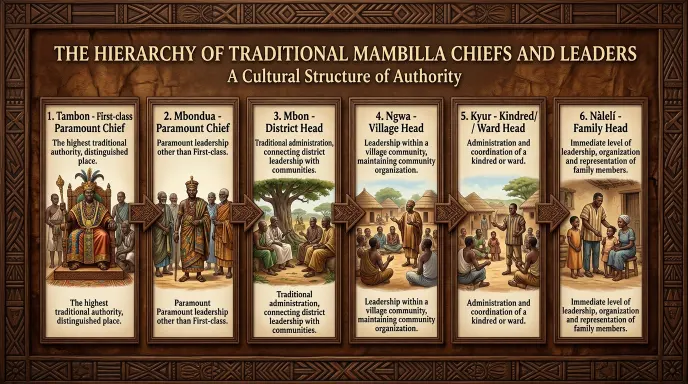
The Hierarchy of Traditional Mambilla Chiefs and Leaders
The traditional leadership system of the Mambilla people is an important aspect of their cultural heritage, social organ…
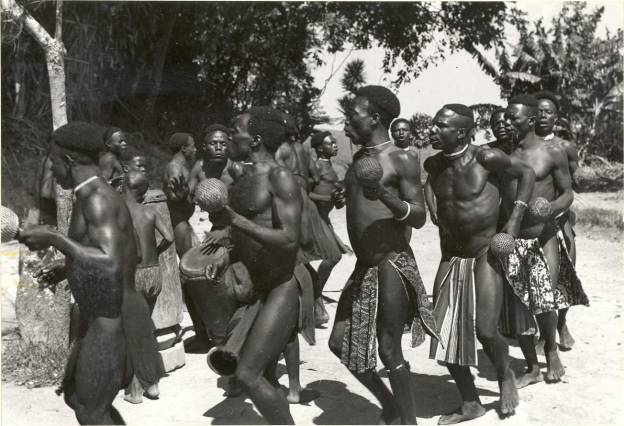
CHANGES IN THE STRUCTURE OF MAMBILLA CHIEFS IN EUROPEAN TIMES
1906–1915: In German Times
30 Mambilla recognized Chiefs were recorded. No other chief besides Mambilla ones. …
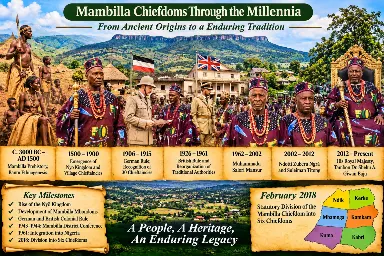
MAMBILLA CHIEFDOMS THROUGH THE MILLENNIA: FROM ANCIENT ORIGINS TO THE MODERN TRADITIONAL INSTITUTION
The history of the Mambilla Chiefdoms is a remarkable account of ancient origins, cultural evolution, traditional govern…

The Urban Metamorphosis of Gembu: From Isolated Sub-Villages to a Unified Plateau Metropolis
The contemporary landscape of Gembu Town, historically and locally known as Bommi, is a fascinating testament to rapid u…